
The Real Cost of Buying Equipment at Auction: What to Budget Beyond the Hammer Price
The winning bid is where your cost starts, not where it ends. Buyers who budget only for the hammer price are the ones who get surprised at pickup — when a rigging crew, a freight bill, and an electrician all turn out to be their responsibility. Buyers who plan for the full landed cost bid with confidence, win the lots they want, and never overpay.
The good news is that none of these costs are truly hidden once you know to look for them. This is a complete, honest breakdown of everything that attaches to an auction purchase, so you can calculate your real total before you place a single bid.
The short answer: Your true total at auction is the hammer price plus the buyer's premium and sales tax, plus the cost to remove, transport, and reinstall the equipment. Those last three — removal, transport, and install — are where buyers get caught, and they're the ones you need to estimate in advance.
The Costs on Your Invoice
Two costs are predictable, and both appear on your invoice the moment you win.
The first is the buyer's premium — a set percentage added to your winning bid. It's standard across the auction industry and funds the cost of running the sale. If you bid $1,000, your invoice reflects the premium on top of that, so factor it into every bid you place. (For how the premium is calculated and why it exists, see our full guide to the buyer's premium.)
The second is sales tax, which applies to your purchase unless you've filed a valid resale or tax-exempt certificate before the sale closes. If you're buying to resell or you qualify for an exemption, get your paperwork in early so the tax comes off your invoice.
These two are easy to plan for because they're a straight percentage of your bid. The costs that trip buyers up are the ones that never touch the invoice at all.
The Costs That Don't Show Up on the Invoice
The real surprises come from getting equipment out of one building and working again in another. These costs are yours to arrange and pay for, and they can rival the hammer price on heavy or specialized lots.
- Rigging and removal labor. Heavy, bolted-down, or oversized assets have to be disconnected, dismantled, and loaded safely. A reach-in cooler you can move with a pallet jack and a friend is one thing; a bolted production line or a long run of pallet racking is another, and it often means hiring a rigging crew.
- Freight and transport. Most auction lots are pickup-only, which means you arrange and pay for hauling. A local win might cost a truck rental and an afternoon; a win three states away can carry real freight expense, so weigh distance before you bid out of your area.
- Electrical and plumbing hookup. Commercial equipment frequently needs licensed installation at its new home — three-phase power, dedicated circuits, gas lines, or water and drain connections. That's a tradesperson's invoice at the destination, not something you handle on pickup day.
- Refrigerant and EPA compliance. Refrigeration carries its own rules. Reclaim at the source is often the seller's responsibility before removal, but once a unit is in your hands, budget for recharging, certified technicians, and EPA-compliant handling to put it back into service.
- Repairs and refurbishment. Auction equipment sells as-is, with no warranty. Even a great deal may need a part, a cleaning, or a service call before it earns its keep, so leave room in your budget for it.
A Simple Formula for Your True Total
Here is the equation worth memorizing:
Hammer price + buyer's premium + sales tax + removal + freight + install/repair = your true landed cost.
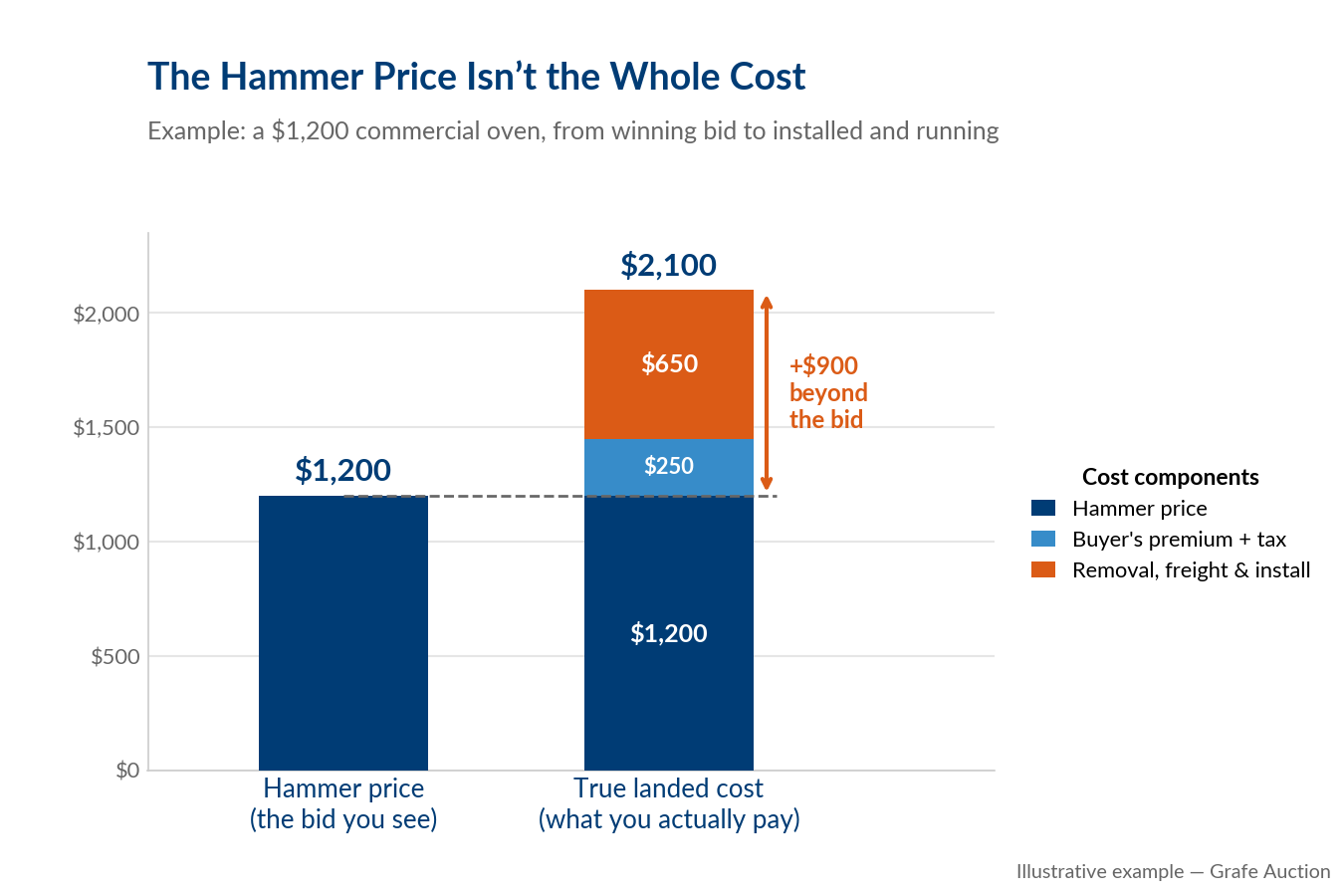
A worked example makes the point. Say you win a commercial oven for a $1,200 hammer price. Add the buyer's premium and local sales tax, and your invoice lands near $1,450. Then add $200 to remove and load it, $150 to haul it across town, and a $300 gas hookup at your restaurant. Your true cost is roughly $2,100 — not the $1,200 on the bid screen. The oven may still be an excellent deal versus buying new, but only the full number tells you that.
The lesson isn't that auction equipment is expensive. It's that the hammer price alone can't tell you whether a lot is a bargain. The landed cost can.
Where Hidden Costs Bite Hardest, by Category
The mix of costs shifts depending on what you're buying:
- Restaurant and foodservice. Gas and water hookups, exhaust and hood work, and NSF considerations drive most of the off-invoice spend. A fryer or range is rarely plug-and-play.
- Grocery and refrigeration. This is the category with the most moving parts: refrigerant handling, licensed electricians, and rigging for cases and compressors. Confirm whether a system is selling as complete or as individual components before you commit, because the difference changes your install cost dramatically.
- Industrial and heavy equipment. Crane and rigging needs, three-phase power verification, and freight on oversized assets are the big line items. Check the power requirements in the listing against what your facility actually supplies before you bid.
How to Estimate All of This Before You Bid
The key to buying well at auction is simple: get your numbers before the sale closes, not after. A few steps make that straightforward:
- Inspect and measure. Check condition, and measure the asset and your access and egress — doorways, docks, and elevators decide what removal will cost.
- Get quotes in advance. Line up rigging and freight estimates while bidding is still open, so your budget is real, not a guess.
- Confirm utilities. Verify power, gas, and water requirements against your site before you commit to install-heavy equipment.
- Ask us. If you're unsure what removal or logistics will involve for a specific lot, contact the Grafe team. We'd rather answer the question before you bid than see a surprise at pickup.
Once you know the all-in number, set your maximum bid so the total still makes sense. That's how you win the right lots at the right price.
The Bottom Line
Budget the full landed cost and the hammer price becomes the easy part. Premium and tax are predictable; removal, freight, and install are where planning pays off. Do that math before you bid, and every auction win is a win you saw coming.
Ready to put it to work? Browse our current auctions, and reach out with any pickup or logistics questions before you bid — we're glad to help you plan the whole number.