
Distribution Center & Warehouse Liquidation Auctions for Racking, Conveyor, Forklifts & Material Handling
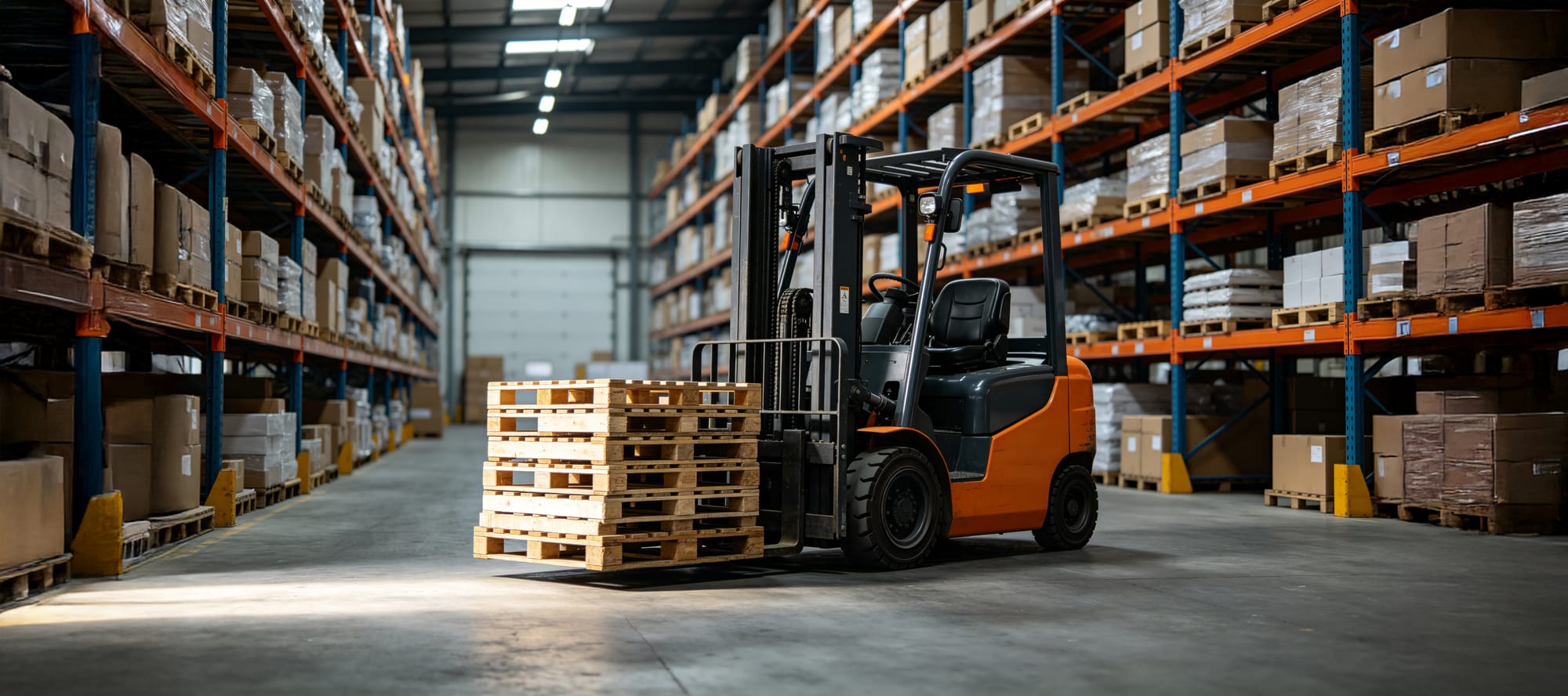
The equipment is not the hard part. The date is.
When a distribution center closes or consolidates, the person running the project is rarely lying awake over what a used forklift is worth. They are lying awake over a lease surrender date, a restoration clause somebody in Legal just forwarded, and the fact that 4,200 pallet positions are still anchored to a slab they have already promised to hand over broom-clean. Recovery dollars matter. But they matter third, behind hitting the date, and behind nobody getting hurt taking the racking down.
That is the order we work in.
Grafe Auction runs full distribution center and warehouse liquidations on a defined schedule: typically four to eight weeks from the initial walkthrough to final load-out (depending on auction size), with cataloging, marketing, the sale itself, buyer payment, scheduled removal, and a reconciled settlement report handled by our team.
We have been running commercial auctions since 1959. Our registered bidder network exceeds 300,000, and we conduct roughly 290 auctions a year nationwide, including corporate distribution center closures in Ohio, Texas, New Jersey, Illinois, Georgia, Tennessee, and Kentucky.
We work with VPs and directors of distribution, supply chain, logistics, and warehouse operations; corporate real estate and facilities leaders; network optimization and program managers running multi-site consolidations; mid-market COOs and operations leaders doing this for the first time; and the lenders, receivers, trustees, and equipment lessors who inherit a facility when a borrower stops answering the phone.
Schedule a Facility Walkthrough
Browse Current Warehouse & Material Handling Auctions
What Is a Distribution Center or Warehouse Liquidation Auction?
A distribution center or warehouse liquidation auction is a competitive online sale of a facility’s physical assets (pallet racking, material handling equipment, conveyor, dock infrastructure, and rolling stock) run by a third-party auction company that catalogs the equipment, markets it to a national buyer network, sells it lot by lot, and coordinates payment and removal.
The distinction that matters is not online versus on-site. It is who owns the work.
- In a liquidation auction, the auction company inventories and photographs every asset, builds the lot structure, markets the sale to buyers who are actively sourcing that specific equipment, runs the bidding, collects and verifies payment, schedules removal windows, and delivers a lot-level settlement report.
- In a dealer sale, you receive one number for a defined list and the equipment leaves on the buyer’s schedule.
- In a self-managed sale, all of it lands on your operations team during the six weeks they can least afford it.
Warehouse assets are unusual in that most of the value is bolted down. Racking, conveyor, mezzanines, and pick modules have to be engineered out safely, in sequence, often around fire suppression and structural anchoring. A restaurant liquidation is largely a matter of loading equipment onto trucks.
“Sellers ask me what their racking is worth. The better question is what it costs them to get it out of the building on time. Answer that one, and the value question mostly answers itself.”
— John Schultz, CAI, AMM — Partner, Chief Marketing & Technology Officer, Grafe Auction
What’s the Timeline for a Full Distribution Center Liquidation?
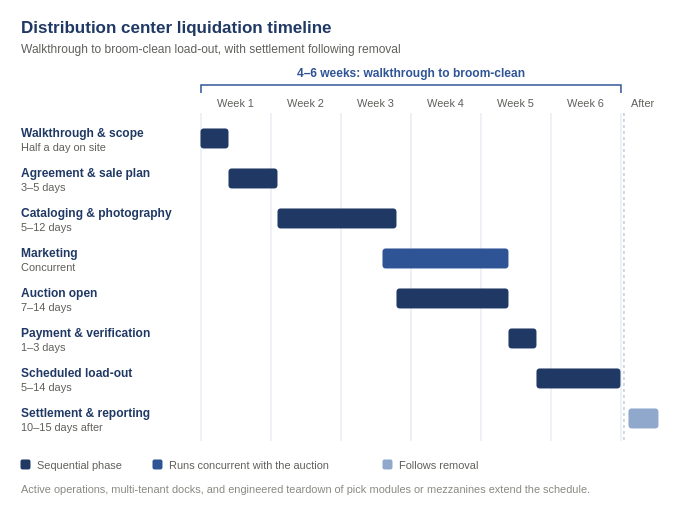
A full distribution center liquidation typically runs four to six weeks from the initial walkthrough to final load-out. This timeline can stretch, however, depending on facility size. Typically, cataloging takes roughly one to two weeks depending on facility size, the auction is open seven to fourteen days to build competition, and removal runs one to two weeks in scheduled windows after the sale closes.
Here is what those weeks actually contain:
We have turned smaller warehouses in under three weeks. A clean facility with organized assets, a single asset owner, dock capacity, an existing equipment list, and a client who can approve the plan in days rather than weeks compresses the timeline.
For a step-by-step walkthrough of a single project from cataloging through load-out, see our detailed guide to distribution center liquidation from start to finish. For facility closures broader than the warehouse itself, see our timeline for closing a commercial facility.
Where Can You Sell Used Warehouse, Material Handling, and Industrial Equipment at Auction?
Grafe Auction sells used warehouse, material handling, and industrial equipment nationwide through online competitive auction. Founded in 1959, we run roughly 290 auctions a year across a registered bidder network exceeding 280,000, covering pallet racking, forklifts, conveyor, dock equipment, rolling stock, and complete distribution center inventories from single-facility closures to multi-site corporate consolidations.
Who buys warehouse equipment:
- Used rack dealers and resellers: buy racking in volume, care about beam profile, upright capacity, teardrop compatibility, and quantity of matching components.
- Forklift and MHE dealers: buy lift trucks by class and brand, price against hour meters, battery condition, and reconditioning cost.
- 3PLs and growing warehouse operators: buy functional systems to outfit or expand a facility at 30–50% of new, with no lead time.
- Manufacturers, contractors, ag operations, and self-storage developers: buy racking, shelving, mezzanines, and lift equipment for uses that have nothing to do with distribution.
- Regional and local buyers: buy the work benches, carts, shop equipment, wire partition, office contents.
A sale that reaches only one of those five leaves money on the floor. Rack dealers do not bid on forklifts. Forklift dealers do not want mezzanine steel. National marketing exists to put all five in the same room on the same day.
Who manages the sale:
Some providers are auction companies. Some are dealers who buy your equipment and resell it themselves. Some are listing platforms that give you an audience and nothing else. We compare all three routes further down this page, including the situations where we are not the right answer.
For a broader look at how industrial assets perform at auction across categories, see our comprehensive breakdown of Industrial & Manufacturing Equipment Auctions for Plants, Shops, Machinery & Production Assets.
What Assets Sell in a Warehouse or Distribution Center Liquidation?
Nearly everything in the building sells. The core categories are pallet racking and storage systems, forklifts and material handling equipment, conveyor and sortation, dock infrastructure, packaging equipment, rolling stock and trailers, and office, breakroom, and IT contents. Facilities closing entirely usually include more auctionable value than operations teams expect.
The table below covers what sells, what drives its value, and how it should be lotted, because lotting decisions move recovery more than almost anything else.
Assets that fall outside these categories still sell. We have handled brewery equipment, theater seating, fitness equipment, and an eleven-foot fiberglass roadside statue. For the buyer-side detail on the three biggest categories, see our material handling equipment buying guide covering forklifts, racking, and conveyor systems.
How Are Used Racking, Forklifts, and Conveyor Systems Valued?
Used warehouse equipment is valued on quantity of matching components, brand and model, measurable condition, and reusability as a system rather than as parts. Racking values on pallet positions and beam profile, forklifts on hour meter and battery condition, conveyor on linear feet and controls generation. Reliable numbers require an on-site count, not a desk estimate.
Book value is the wrong starting point. We routinely see fully depreciated racking outperform a three-year-old conveyor system, because there are hundreds of buyers for teardrop rack and very few for an integrated sortation line with obsolete controls.
What raises value:
- Large quantities of matching components: 2,000 identical pallet positions are worth substantially more per position than four hundred positions in five profiles.
- Documented systems: Rack load charts, conveyor drawings, forklift service records, and hour meter readings all convert buyer risk into buyer confidence, and confidence into bids.
- Recognized brands buyers can source parts for: Toyota, Crown, Raymond, and Hyster on lift trucks. Interlake, Ridg-U-Rak, Steel King, and Unarco on racking.
- Reusability as a system: Conveyor that can be reinstalled as a working run sells for multiples of the same footage sold as sections.
- A complete, broad catalog: Buyers who arrive for a forklift bid on racking, dock equipment, and work benches once they are already registered and already planning a truck.
- Adequate lead time: Cataloging and marketing take time. Sales compressed into ten days from first call reach fewer buyers and clear at lower averages.
An on-site walkthrough beats a phone estimate. Anyone can give you a number over the phone. It will be wrong, and it will be wrong in whichever direction serves the person quoting it. A real valuation requires counting pallet positions, reading capacity plates, checking hour meters, measuring conveyor runs, and understanding what your dock capacity and deadline will actually permit. We do that walkthrough at no cost and with no obligation, and we will tell you when the numbers do not support an auction.
For the factors that apply across all business equipment, see our breakdown of the five factors that determine equipment value at auction.
Request a No-Obligation Walkthrough and Valuation
Auction vs. Dealer Cash Offer vs. Scrap: Which Disposition Method Fits?
A competitive auction usually produces the highest recovery because multiple buyers set the price, but it requires coordinated removal across many buyers. A dealer cash offer is faster and more certain and typically lands below fair market value. Scrap and donation make sense only for assets with no reuse demand. Volume, deadline, and asset mix decide.
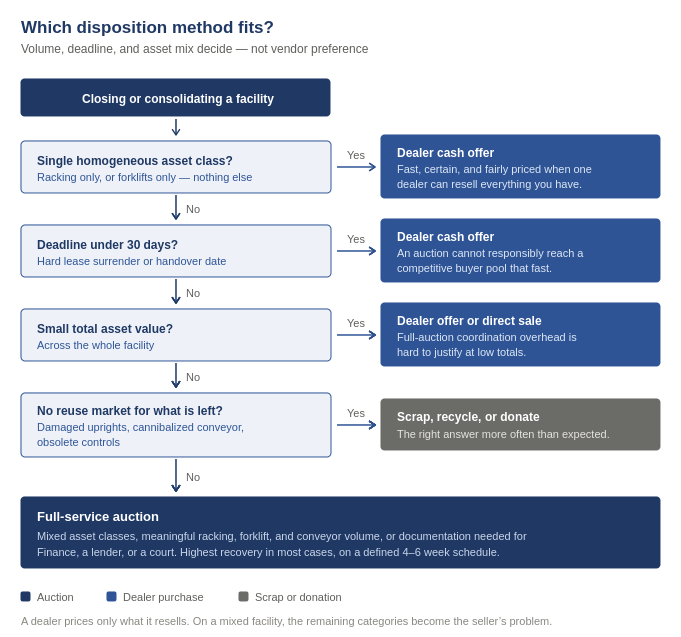
When a dealer cash offer is the better call:
We will say this plainly. If you have one homogeneous asset class, say 1,500 pallet positions of a single teardrop profile and nothing else, a rack dealer who buys, tears down, and hauls it is a clean, fast, defensible transaction. If your deadline is nineteen days, an auction cannot responsibly reach the buyers who would make it competitive. If your total asset value is low, the coordination overhead of a full auction may be hard to justify. In all three cases, take the offer.
When an auction company is the better call:
Mixed facilities. Dealers buy what they resell. A rack dealer will make a strong offer on your racking and a weak-to-nonexistent one on eleven forklifts, four dock levelers, 1,200 feet of conveyor, and the office contents. Those categories then become your problem, on your deadline, with the easy money already gone. That is the scenario where competitive auction separates from everything else, and it describes most distribution center closures.
“If a dealer gives you a fair number for a single-category building and meets a compressed timeline, take it. Our advantage is not that auctions always beat cash offers. It is that we sell the whole building, including the categories nobody else wants to price.”
— John Schultz, CAI, AMM — Partner, Chief Marketing & Technology Officer, Grafe Auction
For a broader framework on evaluating any auction firm, including ours, see our guide to choosing the right auction company for your business liquidation. For the strategic case for auctioning distribution center assets specifically, see unlocking the strategic value of distribution center auctions.
How Is Racking and Conveyor Decommissioning, Rigging, and Removal Handled?
Removal terms are defined before the auction opens, not after it closes. Grafe Auction publishes what each lot includes, who dismantles it, what insurance buyers must carry, and which removal window applies. Items requiring engineered teardown are handled by qualified rigging contractors under documented safety plans.
Who Dismantles What
Every lot states its removal terms explicitly. Freestanding equipment (like forklifts, benches, carts, packaging equipment) is buyer-removed under supervision. Bolted and anchored systems are handled one of two ways: buyer-removed under a contractor the buyer must document and we must approve, or seller-side removal by a rigging contractor engaged as part of the project. Which route applies is decided during the disposition plan, not improvised on load-out day.
Insurance, Contractor Documentation, and Site Rules
Buyers and their contractors provide certificates of insurance meeting your requirements before entering the building. Your site rules (like PPE, check-in, restricted zones, hot-work permits, hours, escort requirements) are published as part of the removal terms and enforced at the door. If your organization requires named-insured or additional-insured endorsements, tell us during scoping and it becomes a condition of removal.
Fire Suppression, In-Rack Sprinklers, and Structural Considerations
Racking removal can affect in-rack sprinkler systems, flue spacing, high-pile storage permits, and ESFR design assumptions. Mezzanines and pick modules interact with egress, lighting, and sometimes with the building’s structural system. Where teardown touches fire suppression or structure, that work sequences with your EHS team, your fire protection contractor, and where applicable the local AHJ. It does not get resolved by a crew with a socket wrench on a Saturday.
Anchors, Slab Condition, and Overhead Work
Rack uprights are anchored. Removing them leaves anchor stubs, holes, or spalled concrete depending on method. Whether anchors must be cut flush, ground, or patched is a lease question. It should be answered before the first upright comes down. Overhead conveyor, spiral units, and pick module decking involve fall protection, lift equipment, and exclusion zones.
Scheduling Load-Out So Your Docks Survive It
Removal is scheduled by window, dock, and zone. Buyers receive assigned times. Payment clears before release. High-volume buyers like rack dealers and forklift dealers moving large lots are sequenced separately from the long tail of local buyers taking one or two items. A site contact from our team is present through load-out, and the building is walked at completion.
For what buyers should expect on their side of removal, see what to expect on auction pickup day and our guide to managing and transporting assets after the auction.
Fixture or Personal Property? Lease Restoration and Landlord Obligations
Whether warehouse racking and conveyor are fixtures belonging to the landlord or personal property you can sell depends on your lease language, how the equipment was installed, and who paid for it. Confirm this before cataloging. Restoration clauses may also require anchor removal, slab patching, or returning the building to a defined condition.
We are not attorneys and this is not legal advice. Your counsel and your lease govern. But it is worth knowing what to look for before you are three weeks from surrender.
The distinction usually turns on three things: what the lease says about trade fixtures and alterations, how the equipment was installed, and who funded it. Racking installed as a tenant improvement with landlord allowance dollars is a different conversation from racking the tenant bought and anchored itself.
Practical sequence we recommend: pull the lease and the original tenant improvement documentation, have counsel and your real estate lead confirm what is yours to sell and what must be removed regardless, then bring us in for the walkthrough. Doing it in that order prevents cataloging assets you cannot legally sell and prevents a landlord claim arriving after settlement.
How Grafe Auction’s Warehouse Liquidation Process Works
Grafe Auction manages the full liquidation in seven steps. One project team owns the engagement from walkthrough to broom-clean.
1. Intake and Deadline Review
We start with the constraint, not the equipment. What is the surrender or handover date? Is the facility still operating? Are there lien, lease, lender, or court considerations? Who has authority to approve the plan? Most of what follows is determined by the answers.
2. Walkthrough and Asset Inventory
An on-site assessment of every category. You receive a documented asset inventory with retained-versus-sold clearly marked, reviewed with your team before anything is committed. This is also where we tell you honestly what is scrap, what should be donated, and whether an auction is the right route at all.
3. Disposition Plan and Sale Structure
Sale structure, lotting approach, marketing plan, removal windows, insurance requirements, site rules, and a recovery range documented and approved before we catalog. Multi-facility programs are sequenced here, and where volume warrants it, categories like semi-trailers are split into their own events to reach their own buyer pool.
4. Cataloging, Photography, and Lot Creation
Our crew inventories, tags, photographs, and lots everything on site. Racking is catalogued by profile, upright capacity, beam length, and pallet position count. Forklifts by make, model, capacity, fuel type, hours, and observable condition. Conveyor by type, width, and linear feet. Photography is thorough and honest — including the damage, because condition surprises produce disputes on load-out day and cost more than the disclosure ever would.
5. Marketing to the Buyer Network
The sale goes to our 280,000+ registered bidders, plus targeted outreach into the specific segments your asset mix requires: used rack dealers, forklift and MHE dealers, 3PL and warehouse operators, regional manufacturers and contractors. Industry-specific campaigns, email, paid placement, and trade outreach as the assets warrant. Marketing is structured around confidentiality.
6. Auction Execution
Online bidding, typically open seven to fourteen days, with inspection access where the site allows. Longer windows draw more registered bidders and more cross-category bidding. Bidding is monitored throughout, and we stay in contact through the close.
7. Settlement, Removal, and Closeout
All funds collected and cleared before release. Removal by assigned window, dock, and zone with a site contact present. Rigging and teardown executed per plan. Building walked at completion. You receive lot-level results and a reconciled settlement statement.
For a look at how the same process runs across a broader facility closure, see our six-step auction roadmap and what sellers actually have to do before an auction goes live.
Lot Strategy: Bulk Lots vs. Piece-by-Piece
Lotting is the highest-leverage decision in a warehouse liquidation. Large matching racking runs sell best in bulk lots that attract rack dealers. Forklifts almost always sell best individually. Support equipment performs best bundled into value lots. A broad, complete catalog outperforms a curated one because buyers cross-bid across categories.
- Racking: bulk, by run. Rack dealers buy volume. Twelve hundred matching pallet positions offered as one lot brings dealer money into the room. The same rack offered in forty small lots brings hobbyists. Odd profiles and mixed components get bundled separately so they do not drag the primary lots down.
- Forklifts: individual, almost always. Lift trucks have discrete, comparable market values and distinct buyers per class. A 5,000 lb electric sit-down and a narrow-aisle turret truck have almost no buyer overlap. Selling them together guarantees one of them clears cheap.
- Conveyor: by functional run. Reusable systems sold as complete documented runs command large premiums over the same footage sold loose. Where controls are obsolete, part it into functional segments and price for reuse of the mechanical components.
- Support equipment: value bundles. Benches, carts, hand trucks, shelving, and shop items bundled by function and location. This is where local buyers concentrate, and it builds the lot count and bidder registration that lift everything else.
- Trailers and rolling stock: separate event where volume allows. Truck and trailer buyers are a different audience with different registration behavior. Splitting them out reaches both pools properly instead of asking one catalog to serve both.
In our Big Lots distribution center work, the asset inventory ran well past core material handling equipment. 1,917 lots of equipment drawing 153,227 bids, alongside a fleet of 173 semi-trailers auctioned in separate events. Buyers who registered for a forklift bid on racking. Buyers who came for racking bid on dock equipment and benches. The broader and more complete the catalog, the stronger the response across every category.
 Grafe Auction
For more on running large and multi-event sales, see our lessons from multi-day, multi-event auctions and large-scale liquidations.
Liquidating Warehouse Assets for Lenders, Receivers, and Trustees
Lenders, receivers, trustees, and equipment lessors engage Grafe Auction directly for warehouse and material handling collateral. We provide asset inventory and valuation support, a publicly marketed competitive sale that documents fair market value was pursued, controlled site access, and lot-level settlement reporting suitable for a court file or creditor waterfall.
Warehouse collateral has a specific problem: a defaulted borrower’s racking and forklifts are worth real money, and the collateral file usually contains an original invoice rather than a current value. Competitive public bidding solves the valuation defensibility question and the disposition question in the same transaction. The market sets the price, the process is documented, and the reporting reconciles.
We work with special assets and workout officers at banks and ABL lenders, court-appointed receivers, Chapter 7 and Chapter 11 trustees, chief restructuring officers, and equipment lessors managing defaulted or end-of-lease forklift fleets. Where a facility is uncooperative or access is contested, we coordinate site entry with counsel and the receiver.
This section is deliberately brief because the full treatment lives on its own hub. See lender recovery, bankruptcy, and receivership auctions for commercial assets for valuation support, timelines, court reporting, and creditor distribution. Also relevant: understanding UCC filings and auction proceeds.
Case Studies
Big Lots Corporate Distribution Centers
Corporate distribution center closures are the largest engagements in this vertical, and the Big Lots work is the clearest example of what scale looks like in practice. The asset inventory extended far beyond core material handling equipment: 1,917 lots of equipment drawing 153,227 bids, plus a fleet of 173 semi-trailers auctioned as separate events to reach the distinct trailer buyer pool.
Weir Furniture Fleet Warehouse Liquidation — Dallas, Texas
A mixed fleet-and-warehouse liquidation covering box trucks, forklifts, and racking from a single facility. The value of this example is the asset mix: it is exactly the combination a single-category dealer would not price completely. Fleet vehicles, lift trucks, and storage systems sold in the same engagement, to three substantially different buyer pools, on one removal schedule.
Home Depot Design Center — Elizabeth, New Jersey
Warehouse inventory and facility contents from a national retailer’s distribution and design center operation, on the East Coast rather than the Midwest. Our distribution center and warehouse engagements have run in Ohio, Texas, New Jersey, Illinois, Georgia, Tennessee, Kentucky, and Minnesota.
 Grafe Auction
Food Service Equipment Warehouses
Food service and supermarket equipment warehouses are a recurring category for us, with events in Louisville, Forest Park, Morton Grove, and Franksville. We publish market analysis on this segment specifically. See our 2025 food service warehouse equipment auction market insights and buyer trends.
For more project detail across retail and industrial engagements, see inside three Home Depot Design Center auctions and the strategic value of distribution center auctions.
Why Distribution Center Operators Choose Grafe Auction
- A date you can commit to internally. Four to six weeks, walkthrough to broom-clean, with the phases defined up front.
- Category breadth in one engagement. Racking, forklifts, conveyor, dock infrastructure, packaging equipment, trailers, office and IT, and the long tail of support equipment catalogued and sold by one team rather than split across three vendors.
- Removal is our problem, not yours. Scheduled windows by dock and zone, insurance and contractor documentation collected before entry, payment cleared before release, rigging sequenced with your EHS requirements, and a site contact present through load-out.
- National buyer demand with segment-level reach. A registered bidder network exceeding 280,000, plus targeted outreach to the specific dealer and operator segments your asset mix requires.
- Minimal burden on your team during the worst weeks. A facility closure is the worst possible time to ask operations staff to photograph and list four thousand items. Our crew handles inventory, cataloging, marketing, sale, and removal coordination while your people focus on the transfer and on the workforce.
- Documentation Finance and Real Estate both accept. Asset inventory, marketing record, bidder participation, lot-level results, reconciled settlement statement, and removal confirmation produced as a matter of course.
- Experience and continuity. Auctions since 1959, roughly 290 a year, more than 2,500 completed since 2019. Licensed and credentialed leadership like John Schultz who holds CAI and AMM designations from the National Auctioneers Association. One project team that stays with your engagement start to finish.
Not sure an auction is the right route yet? Tell us what facility is involved, roughly what is in it, and what date you are working toward. We will give you a view on what the assets are likely to do and what structure fits.
Schedule a Facility Walkthrough
For Buyers: Sourcing Racking, Forklifts, and Material Handling Equipment at Auction
Warehouse and distribution center auctions are among the strongest sources for used pallet racking, forklifts, conveyor, and dock equipment — frequently at 30–50% of replacement cost with no lead time. Assets sell as-is, where-is with published inspection access and removal windows. Registration is free.
What to check before you bid:
- Racking compatibility. Beam profile, upright capacity, connector style, and whether the components match what you already run. Teardrop is not universal, and mismatched connectors turn a bargain into scrap steel.
- Forklift condition markers. Hour meter reading, battery age and condition (a replacement battery can approach the truck’s value), mast and tire condition, fuel type against your facility, and capacity plate rating rather than the seller’s description.
- Conveyor reusability. Controls generation, drive availability, width and configuration against your layout, and whether the run is complete enough to reinstall as a system.
- Removal terms and deadlines. What the lot includes, who dismantles it, whether you need a rigger, what insurance you must carry, and which window you are assigned. On anchored lots this is often a larger cost line than the winning bid.
- Total landed cost. Bid plus buyer’s premium plus applicable tax plus teardown plus transport. Run that number before bidding, not after.
New to this? Start with buying equipment at auction: what every bidder needs to know and how to verify the credibility of machinery listings, then inspection day: what to check before bidding on used commercial equipment, our warehouse auction walkthrough, and how a buyer’s premium works at an online equipment auction.
Sourcing seasonal capacity? See maximizing efficiency with auctioned warehousing equipment.
Browse Current Warehouse & Material Handling Auctions
Frequently Asked Questions About Distribution Center & Warehouse Liquidation Auctions
How Long Does a Full Distribution Center Liquidation Take?
Typically four to six weeks from the initial walkthrough to final load-out. Cataloging takes one to two weeks, the auction stays open seven to fourteen days, and removal runs one to two weeks in scheduled windows. Smaller warehouses can move faster. Active operations, multi-tenant docks, and engineered teardown extend it.
Who Buys Used Pallet Racking and Conveyor Systems?
Used rack dealers and resellers buy racking in volume and care most about matching beam profiles and upright capacity. Conveyor goes to system integrators, resellers, and operators who can reinstall a run. Both categories also draw manufacturers, contractors, ag operations, and self-storage developers.
How Much Is My Warehouse Equipment Worth?
It depends on quantity of matching components, brand and model, measurable condition, and reusability as a system rather than as parts. Book value is not a reliable guide. A real number requires an on-site count of pallet positions, hour meters, and conveyor footage, which we do at no cost and no obligation.
Do You Dismantle the Racking, or Do Buyers?
Both, depending on how the lot is structured. It is defined before the auction opens, not after. Freestanding equipment is buyer-removed. Anchored racking, conveyor, mezzanines, and pick modules are either buyer-removed under an approved and documented contractor, or handled by a rigging contractor engaged as part of the project.
Who Carries Insurance During Removal?
Buyers and their contractors provide certificates of insurance meeting your requirements before entering the building. Your site rules are published as part of the removal terms and enforced at the door.
What Happens to Assets That Don’t Sell?
Unsold assets are addressed in the disposition plan up front. Options include a follow-on sale, negotiated bulk sale, donation with documentation, or scrap and recycling. Where a lease requires removal regardless of value, we build that into the removal schedule rather than leaving it for you to solve afterward.
Can You Run an Auction While the Facility Is Still Operating?
Yes. Cataloging, marketing, and the sale are sequenced around active operations, and removal is scheduled to protect your dock capacity and production. Facilities running through the sale take longer, so tell us during scoping so the schedule reflects it.
Can You Handle Multiple Facilities at the Same Time?
Yes. Multi-site consolidations are sequenced during the disposition plan, with facilities staggered to avoid competing for the same buyers on the same dates, and reporting rolled up so your program office and Finance see the whole program rather than a stack of unrelated sales.
Do You Sell Semi-Trailers, Box Trucks, and Rolling Stock?
Yes, and where volume warrants it we auction them as separate events, because trailer and truck buyers register, inspect, and transport differently than equipment buyers.
How Do You Handle Forklifts With Dead Batteries or Unknown Hours?
They still sell, disclosed. Battery replacement cost gets deducted from bids whether or not you mention it, so honest disclosure of battery age, non-functioning hour meters, and known mechanical issues protects the sale from load-out disputes and protects your credibility with the dealers who bid every one of our sales.
What Documentation Do I Get for Finance and My Landlord?
A documented asset inventory with retained-versus-sold marked, the marketing record, bidder participation, lot-level results, a reconciled settlement statement, and removal confirmation. Enough to close the assets on your books and to support the surrender file with your landlord.
What If My Lease Requires Anchor Removal and Slab Patching?
That obligation should be confirmed with your counsel and real estate lead before cataloging, because it changes the disposition plan. Where restoration is required, removal is scoped to satisfy it, and auction proceeds are best understood as funding the teardown rather than as pure recovery.
Can a Lender, Receiver, or Trustee Engage You Directly?
Yes. We work with special assets and workout officers, court-appointed receivers, Chapter 7 and 11 trustees, chief restructuring officers, and equipment lessors, providing valuation support, controlled site access, a documented competitive sale, and reporting suitable for a court file or creditor waterfall.
Do You Work Nationally or Only in the Midwest?
Nationally. Grafe Auction is headquartered in Stewartville, Minnesota and conducts roughly 290 auctions a year across the country. Our distribution center and warehouse engagements have run in Ohio, Texas, New Jersey, Illinois, Georgia, Tennessee, Kentucky, and Minnesota.
How Do I Get Started?
Send us the facility location, a rough sense of what is in it, and the date you need the building empty. We will schedule a walkthrough, provide a documented asset inventory and a recovery range at no cost, and tell you honestly whether an auction is the right route.
Ready to put a date on it? Tell us the facility, the asset mix, and the deadline. We will walk the building and give you a documented inventory, a realistic recovery range, and a load-out schedule you can take to your leadership.