
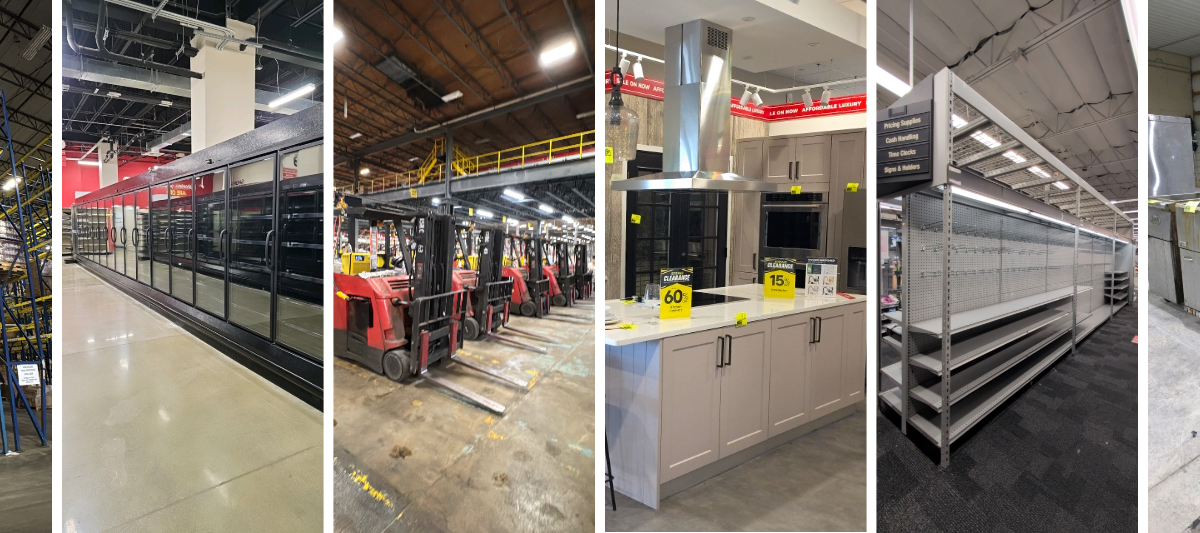
Resellers source bulk lots of used business equipment from commercial liquidation auctions, where a closing restaurant, grocery store, warehouse or plant sells its entire contents in one event. This is commercial equipment, not the consumer-returns pallets sold on overstock sites. Grafe Auction runs about 290 online auctions a year across all 50 states plus Puerto Rico, and we have been selling commercial and industrial equipment since 1959. That schedule puts a steady supply of restaurant kitchens, grocery refrigeration, store fixtures, forklifts, racking, and shop equipment in front of more than 300,000 registered bidders.
If you are an equipment dealer, refurbisher, exporter, or small reseller looking for consistent inventory, this guide covers where bulk lots come from, how the main sourcing channels compare, and how to figure your true cost before you bid.
The best bulk source is the one that gives you volume, clear lot descriptions, and pickup terms you can plan around. Commercial liquidation auctions deliver all three because each closing site is cataloged, photographed, and scheduled for removal before bidding opens.
What Are the Best Places for Resellers to Buy Bulk Used Business Equipment?
Resellers source bulk used business equipment from five main channels: liquidation auction companies, multi-seller auction marketplaces, retail returns platforms, government surplus sites, and direct buyouts from closing businesses.
Each channel fits a different type of reseller. Here is how they compare.
| Sourcing channel | Examples | What you typically find | Best fit for |
|---|---|---|---|
| Commercial liquidation auction companies | Grafe Auction | Complete contents of closing restaurants, grocery stores, distribution centers, retail chains, and plants | Dealers and refurbishers who want commercial equipment by category, with preview and pickup terms set for each event |
| Multi-seller auction marketplaces | BidSpotter, Proxibid | Catalogs from many independent auction houses in one place | Buyers who want to browse widely and can work with terms that vary by auction house |
| Retail returns and overstock marketplaces | B-Stock, Liquidation.com | Pallets and truckloads of consumer goods, returns, and overstock | Resellers of consumer merchandise rather than commercial equipment |
| Government and surplus sites | GovDeals, AllSurplus | Vehicles, IT equipment, furniture, and surplus from public agencies and businesses | Buyers who want public-sector surplus and can travel to many pickup sites |
| Direct buyouts | Closing business owners, landlords | Whole-site contents negotiated privately | Experienced buyers with cash, crews, and trucks to clear a site fast |
Grafe Auction focuses on business equipment, not consumer returns. Our events are built around commercial liquidations: a restaurant closing, a grocery remodel, a distribution center consolidation, or a multi-store chain closure. For a reseller, that means you can follow the categories you know and buy them in volume.
How to Source Bulk Lots at Auction: The Process at a Glance
Sourcing bulk inventory at a Grafe Auction event follows eight steps.
- Create a bidder account at grafeauction.com.
- Send your resale certificate to our team before invoicing so qualifying purchases are not taxed.
- Turn on notifications and join the mailing list to hear about new auctions in your categories.
- Read each event's Removal, Shipping, and Special Terms document before you bid. It sets pickup dates, hours, and any appointment rules.
- Attend the preview or study the photos and written description to judge condition, since items sell as-is.
- Calculate your landed cost and set a maximum bid for each lot.
- Pay your invoice by noon the day after the auction.
- Schedule pickup and freight inside the removal window.
What types of closures produce the most bulk inventory?
Chain closures, distribution center consolidations, and full-facility liquidations produce the deepest inventory because one seller lists hundreds or thousands of similar lots at once. Here is what each category typically includes.
Grocery and supermarket equipment
Supermarket closings and remodels bring Hussmann and Hill Phoenix refrigerated cases, walk-in coolers, deli slicers, bakery ovens, checkout lanes, and gondola shelving. See our supermarket equipment buyer's guide for what to check on each.
Restaurant and food service equipment
Restaurant closings bring Hobart mixers, True reach-in refrigerators, Manitowoc ice machines, Vulcan ranges, stainless prep tables, and smallwares. Food service warehouse events add depth when a supplier or distributor clears its stock.
Distribution center and warehouse equipment
Warehouse liquidations bring Crown, Raymond, Toyota, and Yale forklifts, Interlake and Steel King pallet racking, conveyor, and dock equipment. Our material handling buying guide covers what to inspect.
Retail store fixtures
Multi-store retail closures bring gondola shelving, display cases, checkout counters, and back-room storage in matching sets, which suits resellers who sell fixtures by the run.
Manufacturing and shop equipment
Plant and shop closures bring CNC machines, Lincoln and Miller welders, air compressors, and tooling.
Our Big Lots distribution center auctions offered 1,917 lots of equipment that drew 153,227 bids, and in 2025 we sold 647 Big Lots semi-trailers across eight auctions.
National liquidations put that kind of volume in front of bidders at once. Three Home Depot Design Center auctions in April 2026, in Vauxhall, New Jersey; Rockville, Maryland; and San Diego, California, sold 2,134 floor-model lots at a sell-through rate above 95% and drew nearly 167,000 bids. Read the full Home Depot Design Center customer spotlight for the breakdown by location.
How do you calculate your true cost on a bulk lot?
Your true cost on a bulk lot is the hammer price plus the buyer's premium, sales tax if you have no resale certificate on file, removal, freight, and any repair or refurbishing. Your margin is the resale value minus that total, not minus the winning bid.
The buyer's premium rate is listed in the terms at the top of each Grafe Auction event page. Check it on every event, then build your maximum bid backward from the number you need to resell at.
On multi-unit lots, divide your all-in cost by the number of pieces. If a lot holds 20 sections of shelving, your per-section cost is what you compare against your resale price, not the lot total.
For a full breakdown with a worked example, see The Real Cost of Buying Equipment at Auction.
How do resellers handle pickup on large or multi-lot wins?
Resellers handle pickup by planning removal before they bid. Each Grafe Auction event publishes its pickup dates and hours, and the windows vary by category:
- Restaurant auctions typically allow 2 to 3 days for removal.
- Grocery auctions typically allow 5 to 7 days.
- Industrial auctions typically allow 7 days or more.
Shipping is the buyer's responsibility, so line up trucks, labor, and any rigging before the auction closes. Items left after the removal window may be resold or disposed of, and you may be charged a disposal fee.
Refrigeration resellers should know that the seller has the refrigerant reclaimed before the auction. Disconnecting and removing what you buy is your responsibility. Many events list an independent removal contractor on the auction page and at the bottom of your invoice. You hire them directly, they set their own rates, and they are not Grafe Auction employees. Our guides to auction pickup day and transporting your new assets cover the details.
Do resellers pay sales tax on auction purchases?
Resellers do not pay sales tax on qualifying purchases when a valid resale certificate is on file before invoicing. Sales tax is based on where the auction is, so without a certificate you'll see that state's rate on your invoice.
Send your certificate to our team and we'll mark your account so tax comes off qualifying purchases. A valid certificate from your home state works at most of our auctions, and we also accept the Streamlined Sales Tax certificate and the Multistate Tax Commission uniform certificate. A few states have their own requirements for out-of-state buyers, and we'll tell you if yours does. If you won before your certificate was on file, send it anyway and we'll look at your current invoice. Our sales tax and tax exemption guide walks through the steps.
How can resellers track new commercial auctions across states?
Resellers track new commercial auctions by setting up account notifications, watching specific lots, and joining an auction company's mailing list. Grafe Auction notifications include outbid alerts, event reminders, in-ring reminders, and won-item notices. Keyword alerts are especially useful for resellers: add words like "forklift" or "walk-in cooler" under Account > Notification Settings and you'll get an email when a matching lot is added to any catalog. Watch the lots you care about so the reminders reach you in time.
Timing matters on closing day. Grafe Auction lots close one at a time at roughly 70 to 100 lots per hour, and any bid in the final seconds resets a short countdown, usually 15 seconds. On a large sale, lot 300 typically closes three to four hours after the first lot. Set your maximum bids early, since you cannot raise a max bid once a lot starts its closing countdown.
Browse upcoming Grafe Auction events and join our mailing list to see new liquidations as they are announced.
What happens if an auction lot isn't as described?
Auction lots sell as-is, where-is, in their current condition and location, unless the event terms say otherwise. That is why preview days and careful reading of catalog descriptions matter so much for resellers.
If a lot is materially different from its written description, such as the wrong model or a listed component missing, email our team within two business days of taking possession. Cosmetic wear isn't covered, and the description, not the photos, defines what's in the lot. Accurate cataloging is part of how we keep repeat dealers coming back. Our guide to reading an auction catalog listing shows what to look for.
The Bottom Line for Resellers
Resellers who want steady, volume inventory of commercial equipment get it from liquidation auctions that sell whole sites at once. Grafe Auction runs about 290 of those auctions a year across all 50 states plus Puerto Rico, covering grocery, restaurant, warehouse, retail, and manufacturing equipment.
Before you bid, file your resale certificate, read the removal terms, and calculate your landed cost per unit. Then browse our upcoming auctions and start building your next load.
Frequently Asked Questions
Where can resellers buy used business equipment in bulk?
Resellers buy used business equipment in bulk at commercial liquidation auctions, multi-seller auction marketplaces, government surplus sites, and through direct buyouts. Grafe Auction runs about 290 liquidation auctions a year across all 50 states plus Puerto Rico.
Do I need a resale certificate to buy at Grafe Auction?
A resale certificate is not required to bid, but without one on file, purchases are taxed at the rate where the auction takes place. A valid certificate from your home state works at most of our auctions.
How long do I have to pick up equipment after an auction?
Removal windows vary by event. Restaurant auctions typically allow 2 to 3 days, grocery auctions 5 to 7 days, and industrial auctions 7 days or more. Each event's Removal, Shipping, and Special Terms document lists exact dates and hours.
When is payment due after winning a Grafe Auction lot?
Payment is due by noon the day after the auction. Grafe Auction accepts Visa, MasterCard, American Express, Discover, and ACH bank transfer, and wire transfer is available for large purchases by prior arrangement.