
Do you suddenly find yourself asking the question, "How do I sell the equipment from my closed business?"
Closing a business can be one of the most challenging experiences for any business owner. Beyond the emotional toll, there's the practical matter of what to do with your equipment and assets. The good news is that selling your business equipment can recover significant value and provide closure during this transition period.
At Grafe Auction, we've been helping business owners sell equipment from closed businesses since 1959. Our experience has shown that with the right approach, you can maximize returns and make the process as smooth as possible.
Selling equipment is one part of shutting down a business. For the full sequence, including your attorney, employees, the lease and final taxes, see our closing down a business checklist.
For many owners, the next questions are practical:
- How quickly can I liquidate everything?
- Should I sell the equipment myself or hire a commercial auctioneer?
- What documentation do I need?
A structured auction can address all three by combining asset preparation, targeted buyer marketing, a defined sale date, payment collection, and coordinated removal within one process.


Creating an Inventory of Equipment to Sell
The first step in selling equipment from a closed business is determining exactly what you have to sell. Creating a comprehensive inventory helps you organize the process and enables potential buyers to understand what's available.
Equipment commonly sold at business liquidation auctions includes:
- Food Service Equipment
- Restaurant equipment (ovens, grills, refrigerators)
- Commercial kitchen equipment (mixers, food processors, prep tables)
- Grocery store and supermarket equipment (display cases, coolers, shelving)
- Manufacturing and Industrial Equipment
- Woodworking machinery
- Machine shop equipment
- Metal fabrication tools
- Production line systems
- Other distribution center assets
- Retail Fixtures and Assets
- Store fixtures and shelving
- Display cases and mannequins
- Cash registers and POS systems
- Inventory and merchandise
- Office Assets
- Furniture (desks, chairs, conference tables)
- Electronics (computers, phones, printers)
- Art and décor
- Office supplies
- Specialized Equipment
- Fitness and gym equipment
- Medical and dental equipment
- Educational and classroom supplies
- Construction tools and machinery
- Vehicles and Transportation
- Delivery trucks
- Forklifts and pallet jacks
- Company cars
- Commercial Real Estate
- Buildings
- Land
- Warehouses


Gathering Required Documentation
You don't need to create a perfect auction catalog before contacting an auction company, but having accurate records available can make the process smoother and help buyers bid with confidence. Useful documentation includes:
- Make, model, and serial numbers when available
- Maintenance and service records
- Owner's manuals and warranty information
- Purchase records or depreciation schedules, if available
- Titles for vehicles or other titled assets
- Information about equipment leases or third-party-owned assets
- Records of any liens or secured loans tied to the equipment
- Notes about recent repairs, upgrades, or known operating issues
Be especially clear about which assets are being sold and which are staying behind. Grafe Auction handles the formal cataloging, photography, lot creation, and descriptions, so sellers generally don't need to build the finished inventory themselves.
For a more detailed preparation checklist, see What Grafe Auction Needs to List Your Equipment for Auction.
Understanding Financial Obligations
Before selling your business equipment, it's essential to understand if there are any liens or financial obligations attached to these assets.
If You Owe Money on Your Equipment
When you have outstanding loans on equipment you intend to sell, follow these steps:
- Contact your creditors: Communicate your intention to sell the equipment.
- Review loan agreements: Understand your obligations regarding sale of collateral.
- Negotiate payoff amounts: In some cases, creditors may accept less than full payment, especially if the equipment value has depreciated below the loan amount.
- Understand priority of payment: Proceeds from equipment sales typically go first to secured creditors up to the amount you owe them.
Special Considerations for SBA Loans
If your business equipment was purchased with a Small Business Administration (SBA) loan, there are additional requirements:
- SBA loans often require specific notification procedures before selling collateral
- Your lender may need to approve the sale method and minimum acceptable prices
- Additional documentation is typically required
- The SBA may have specific requirements for the auction or sale process


Options for Selling Your Business Equipment
When it comes to liquidating business assets, you have several options, each with its own advantages and disadvantages:
Selling Directly to Equipment Dealers
Pros:
- Fastest access to cash
- Minimal effort required
- One-stop solution for multiple items
Cons:
- Typically offers lowest return (30-50% of fair market value)
- Dealers only buy what they can easily resell
- May need to find multiple dealers for different equipment types
Equipment dealers need to purchase at wholesale prices to make a profit when reselling. While this option provides quick cash, it generally yields the lowest return on your assets.
Selling Directly to Similar Businesses
Pros:
- Can yield higher prices (60-80% of new value for good condition items)
- No commission fees
- May build goodwill in your industry
Cons:
- Time-consuming process
- Requires significant effort to find buyers
- Cherry-picking of best items often occurs
- May leave less desirable equipment unsold
This approach can work well for high-value specialty equipment but becomes increasingly challenging for complete liquidation of all assets.
Selling Through Auction
Pros:
- Competitive bidding drives prices up
- Comprehensive solution for all equipment
- Professional marketing reaches motivated buyers
- Complete closure in a defined timeframe
- Minimal work required from you
Cons:
- Requires adequate planning and marketing time before the auctionTakes (typically 2-4 weeks from start to finish)
- Includes commission fees (offset by higher sale prices)
- Less control over final prices
Auctions create a competitive environment where interested buyers bid against each other, often resulting in optimal market prices for your equipment. The competitive nature of auctions frequently generates higher overall returns than private sales, particularly when selling a complete business worth of equipment.
Why Choose Auction for Business Liquidation
Auctions have become the preferred method for business liquidation for several compelling reasons:
1. Market-Driven Pricing
Auctions let the market determine the true value of your assets. When multiple interested buyers compete for items they want, prices naturally rise to what the market will bear.
2. Complete Liquidation
Unlike other methods where only the best items sell, auctions can move your entire inventory in one event. This comprehensive approach prevents you from being left with unwanted items.
3. Defined Timeline
Auctions operate on a set schedule, giving you a clear endpoint for the liquidation process. This timeline allows for better planning during your business transition.
4. Professional Marketing
Professional auction companies like Grafe Auction implement comprehensive marketing strategies to reach targeted buyers interested in your specific equipment. This specialized marketing often brings in buyers willing to pay premium prices for quality equipment.
5. Minimized Effort
A full-service auction company handles the entire process—from inventory and cataloging to marketing, sales, and removal—allowing you to focus on other aspects of your business transition.
6. Transparency
The open, public nature of auctions ensures a fair process for all parties involved and eliminates concerns about undervalued private sales.
The Auction Process at Grafe Auction
When you choose Grafe Auction to sell your business equipment, here's what you can expect:
- Initial Consultation: We'll discuss your equipment, timeline, and goals.
- Site Visit: Our team will evaluate your equipment and develop a customized auction plan.
- Preparation: We'll catalog, photograph, and organize your assets for presentation.
- Marketing: Your equipment will be marketed to our database of over 229,000 active bidders plus targeted advertising to reach new potential buyers.
- Auction Event: We'll conduct a professional online auction with competitive bidding.
- Payment Processing: We'll collect payments from buyers promptly.
- Removal Coordination: We'll oversee the removal of sold items, ensuring your property is left in broom-swept condition.
- Final Settlement: You'll receive detailed settlement reporting and, in most cases, proceeds within approximately 12 business days of the auction's conclusion.


Maximizing Your Equipment's Value
To get the most from your business equipment auction:
- Gather Documentation: Collect all owner's manuals, maintenance records, and warranty information for your equipment.
- Basic Cleaning: Clean equipment makes a better impression. You don't need to refurbish items, but basic cleaning helps.
- Organize Equipment: Group similar items together where possible to help with the cataloging process.
- Identify Key Features: Make note of any special features, upgrades, or recent maintenance that might increase value.
- Be Transparent About Condition: Honesty about equipment condition builds trust with buyers and prevents post-sale issues.
Frequently Asked Questions About Selling Equipment From a Closed Business
What’s the fastest way for a small business to liquidate equipment locally?
For a business with multiple assets to sell, a managed online auction can be one of the most efficient ways to complete a liquidation within a defined timeframe. A full-service auction company can catalog the assets, market them to qualified buyers, conduct the sale, collect payments, and coordinate removal rather than requiring the owner to manage individual listings and transactions. Grafe Auction’s business liquidation services are designed to bring those steps together in one process.
What should a business owner expect when hiring a commercial auctioneer?
A full-service commercial auctioneer should help with more than the bidding itself. Business owners can generally expect support with asset review, sale planning, cataloging, photography, marketing, bidder management, payment collection, removal coordination, and final settlement reporting. We explain the process in more detail in What Sellers Actually Have to Do Before an Auction Goes Live.
Should I sell business items myself or hire a local auctioneer?
Selling items yourself may make sense if you only have a few assets and enough time to manage pricing, listings, buyer questions, payments, and pickup. For a complete business closure involving many types of equipment, a professional auctioneer can reduce the seller’s workload and help reach a larger pool of qualified buyers. Before deciding, consider the number of assets, your timeline, removal requirements, and how much of the process you want to manage yourself.
What documentation is needed when selling business equipment from a closed store?
Helpful documentation can include equipment make and model information, serial numbers, maintenance and service records, manuals, warranty information, vehicle or equipment titles, lien information, lease agreements, and records of recent repairs or upgrades. Sellers should also clearly identify which assets are included in the sale and disclose known condition issues. For more preparation guidance, review What Grafe Auction Needs to List Your Equipment for Auction.
For a single-store remodel with a three-week window, what should I look for in a turnkey auction partner?
Start by confirming whether the auction company can work within your required sale, removal, and facility-handoff dates. Ask who will handle cataloging, marketing, payments, pickup scheduling, and final cleanout, as well as when seller proceeds are expected. Grafe Auction generally recommends allowing adequate marketing time before an auction, so a three-week total project window requires early coordination and a clearly defined schedule. When comparing providers, focus on the complete timeline and level of service rather than the auction date alone.
What’s the typical turnaround time from listing to payment for a small business auction?
Timing varies based on the number of assets, marketing requirements, site deadlines, and removal complexity. Grafe Auction generally recommends allowing roughly two to four weeks for auction marketing when possible, and most sellers receive proceeds after buyer payments have cleared and the auction has been reconciled. Sellers with a firm closure or remodel deadline should establish the auction, removal, and settlement schedule during the initial planning process.
How do I prepare my assets for an online auction in Minnesota?
Minnesota sellers should start by identifying which assets will be sold, gathering available titles and equipment records, disclosing liens or leases, and clarifying the property-access and removal timeline. Separate or clearly mark anything that is not part of the sale. If refrigeration or specialized equipment requires professional disconnect or other handling before removal, account for that in the project schedule. Grafe Auction’s pre-auction seller checklist provides additional preparation guidance.
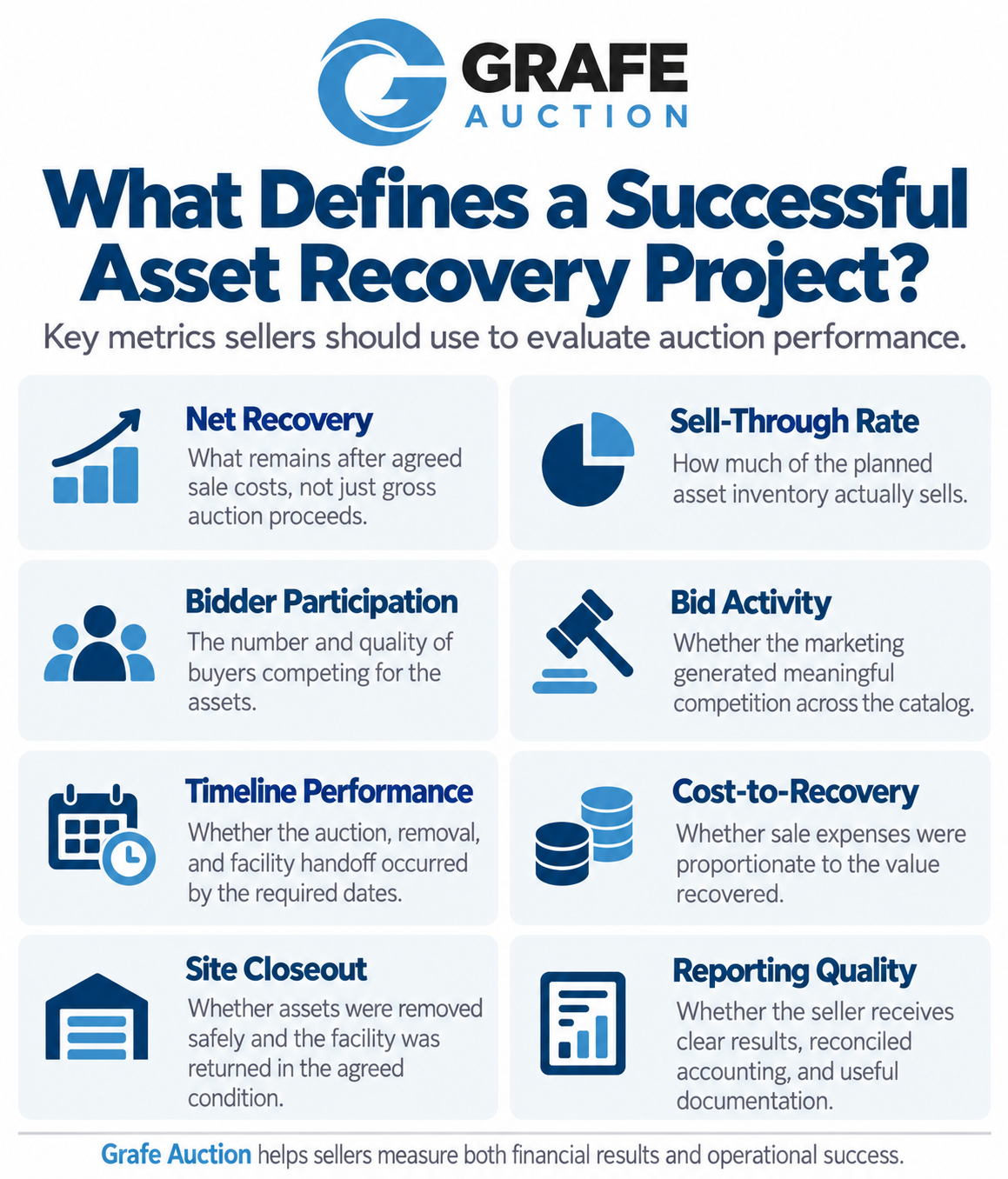
What metrics define a successful asset recovery project?
Sale proceeds matter, but they’re only part of the picture. A successful asset recovery project can also be evaluated by net recovery, sell-through rate, bidder participation, bid activity, timeline performance, cost-to-recovery, successful site closeout, and the quality of post-sale reporting. Looking at both financial and operational results provides a more complete view of how well the liquidation performed. Grafe Auction’s auction roadmap explains how the different stages of a sale work together to support those outcomes.
Make the Most of Your Business Equipment Liquidation With Grafe Auction
The right liquidation strategy should balance four things: recovery value, speed, seller workload, and a clean closeout. Understanding those goals before the sale makes it easier to decide whether self-selling, a dealer, or a full-service auction is the right fit for your situation.
Selling equipment from a closed business doesn't have to be overwhelming. With the right approach, you can maximize returns and simplify the process. At Grafe Auction, we specialize in helping business owners through this transition with professional service and maximum returns.
Since 1959, we've developed expertise in marketing and selling business equipment across numerous industries. Whether you're selling restaurant equipment, retail fixtures, manufacturing machinery, or office assets, our team has the experience to help you achieve the best possible results.
Ready to discuss how we can help you sell your business equipment? Contact us today for a free consultation and learn how our auction services can provide the best return with minimal effort on your part.
Not ready? Learn more about selling with Grafe Auction.