Preserving Americana: How The Gemini Giant Auction Became A Cultural Preservation Success
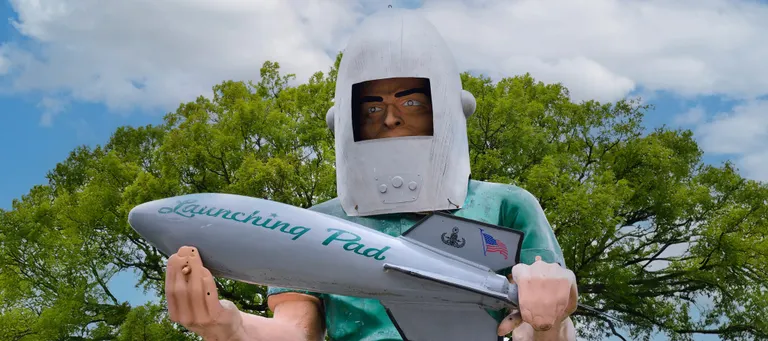
The 2024 auction for The Launching Pad featured more than just a space-themed restaurant's contents. Standing 28 feet tall outside the establishment, the bright green Gemini Giant statue commanded attention as the true centerpiece of the event. This iconic "Muffler Man" had stood as a beloved Route 66 landmark since 1965, drawing visitors from across the globe. When this historic monument entered the auction ring in March 2024, the stakes extended far beyond a typical sale—it represented a pivotal moment for Wilmington, Illinois, and the entire Route 66 heritage community, who feared losing an irreplaceable piece of American roadside history.
At Grafe Auction, we had the privilege of managing this historic auction, which ultimately resulted in not only a record-breaking sale price of $275,000 but also a heartwarming preservation success story that brought together a community and kept a piece of American roadside history right where it belonged.
Although the Gemini Giant was anything but an ordinary asset, the sale illustrates a challenge common to estate and business liquidations: very different types of property may need to be cataloged, marketed, and sold within one coordinated project while still reaching the right buyers for each asset category.
A Route 66 Icon at Risk
The Gemini Giant was placed outside the Launching Pad Drive-In in Wilmington when America's space race excitement was at its peak. This towering fiberglass figure—part of the famous "Muffler Men" series from that time—stood apart with its custom space helmet and rocket modifications, celebrating NASA's Gemini program and capturing the nation's fascination with space exploration.
Over the decades, the Giant became one of Route 66's most recognizable landmarks, drawing travelers from across the globe. In 2000, the statue and restaurant were inducted into the Illinois Route 66 Hall of Fame, cementing their place in American roadside culture.1
Like many historic businesses along Route 66, the Launching Pad faced its share of challenges. After changing hands several times and enduring a pandemic closure, the property's future became uncertain. By early 2024, the statue's owner had made the difficult decision to sell the Gemini Giant separately from the restaurant property.
Navigating Complex Circumstances
When Grafe Auction was approached about handling this sale, we recognized immediately that this wasn't an ordinary auction. The statue's immense cultural significance to the Route 66 community and its importance to Wilmington's identity meant we needed a carefully calibrated approach.
The auction environment was complicated by several factors, including:
- Considerable public concern about the statue potentially leaving Wilmington
- Local grassroots preservation efforts, including fundraising campaigns
- Significant media interest from both local and national outlets
- The need to generate sufficient competitive bidding while respecting the statue's cultural value
For Grafe Auction, the Gemini Giant auction represented not just a business opportunity but a delicate mission requiring expertise in both marketing and stakeholder management. Our team recognized that beyond connecting a historically significant American icon with the right steward, we needed to carefully navigate the complex human factors involved to ensure the statue's preservation.
A Strategic Marketing Approach
Our team developed a multi-channel marketing strategy that balanced the need to generate substantial interest while maintaining appropriate sensitivity to the community's concerns:
- Digital Advertising: Carefully targeted Meta ads and Google search campaigns that reached Route 66 enthusiasts, collectors, and cultural preservation organizations
- Organic Social Media: Strategic content across Facebook, Instagram, and YouTube highlighting the Giant's history and cultural significance
- Media Relations: Press release distribution and media outreach resulting in coverage across local and national news outlets
- Targeted Outreach: Direct communication with museums, historical societies, and specialized collectors
- On-Site Preview Event: An in-person viewing opportunity that allowed potential bidders to connect with the historic statue
Rather than pursuing maximum visibility at all costs, we implemented a measured approach focused on quality engagement with relevant audience segments. This strategic restraint proved crucial in creating an environment where the statue could achieve its full market value while promoting a positive preservation outcome.
That same principle matters in mixed-asset auctions. Vehicles, collectibles, equipment, furnishings, and specialty assets don't necessarily attract the same bidders, so cataloging and marketing should account for the buyer audience surrounding each category rather than treating every lot the same way.
Record-Breaking Results
The carefully executed marketing campaign generated exceptional engagement:
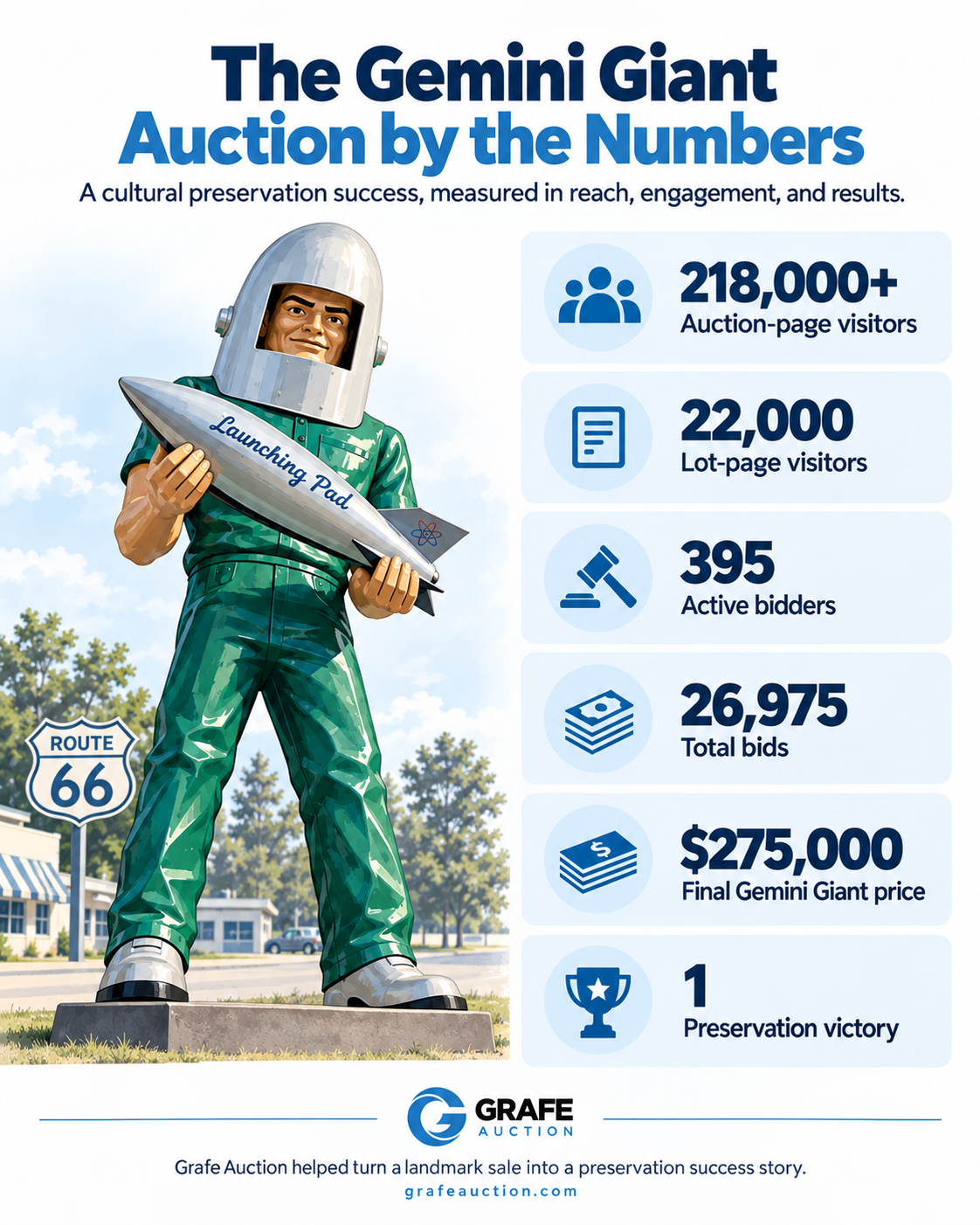
- Over 218,000 visitors to the auction page on our website
- Nearly 22,000 visitors specifically to the Gemini Giant's lot page
- 395 active bidders participating in the auction
- 26,975 bids placed across all items
- A remarkable final price of $275,000 for the Gemini Giant
These numbers tell only part of the story, however. The true measure of success was what happened after the auction concluded.
A Preservation Victory
In a heartwarming twist, the winning bidder was revealed to be the Joliet Area Historical Museum, which immediately announced its intention to donate the statue to the City of Wilmington. This ensured the beloved landmark would remain in its hometown for future generations to enjoy.
The Chicago Tribune captured the dramatic conclusion to the auction, describing how Ryan Jandura, a Wilmington resident who had helped raise nearly $60,000 through a GoFundMe campaign, joined forces with the Joliet Area Historical Museum during the final moments of bidding:
"During the March 20 auction, Jandura huddled with Gregory Peerbolte, CEO of the Joliet Area Historical Museum, in Peerbolte's office. Jandura, a Wilmington resident and supervisor at a 911 dispatch center, had helped raise nearly $60,000 through a crowd-funding campaign and other fundraisers to 'save the statue,' preparing to chip in if the price tag climbed above the museum's budget from a state grant.
'There was like four seconds left on the clock and I was like 'Do you want me to bid? Do you want me to bid?' and I had my finger on the button ready to push it,' Jandura said. 'I could hear him saying 'It's not letting me,' so I hit it.'"2
The successful preservation of the Gemini Giant generated substantial positive media coverage and community goodwill, demonstrating how strategic auction marketing can serve both commercial interests and cultural heritage objectives.
Lessons in Cultural Preservation Through Auctions
The Gemini Giant auction offers valuable insights for handling culturally significant items:
- Community Sensitivity: Understanding and respecting the emotional connections communities have to local landmarks is essential when marketing historically significant items.
- Balanced Marketing: The most effective approach isn't always maximum visibility—sometimes a carefully calibrated strategy that targets the right audiences is more effective.
- Stakeholder Management: Working closely with all parties involved, from sellers to community organizations, helps ensure positive outcomes.
- Cultural Stewardship: Auctions can serve as powerful vehicles not just for commerce, but for cultural preservation and community building.
At Grafe Auction, we're proud that our expertise helped facilitate not just a successful sale, but a meaningful preservation victory. The Gemini Giant will continue to stand tall along Route 66, welcoming travelers and serving as a reminder of America's rich roadside heritage.
As we look to the future, we remain committed to bringing this same level of care and expertise to all our auctions, recognizing that behind every item there's a story worth preserving.
Looking to sell historically significant property, manage an estate liquidation, or coordinate the sale of mixed assets across one or multiple locations? Contact Grafe Auction to discuss your assets, timeline, and the auction strategy that best fits the project.
Frequently Asked Questions About Estate and Mixed-Asset Auctions
What's the process for liquidating estate property through online auctions?
An estate auction typically begins with reviewing the property, identifying what will be sold, and confirming any ownership or documentation requirements. From there, assets are organized into appropriate lots, cataloged and photographed, marketed to potential buyers, sold through online bidding, paid for, and removed according to a defined schedule.
With a full-service auction company, much of that work can be handled on the seller's behalf. Grafe Auction manages cataloging, photography, marketing, the auction itself, buyer payment, and removal coordination while the seller provides access and accurate information about the property. For a closer look at the types of assets commonly included, see personal property auction trends and recent estate sales.
How do estate auctions handle mixed assets like vehicles and collectibles?
Mixed-asset estates can be managed as one coordinated liquidation without treating every asset exactly the same. Vehicles may require titles and additional documentation, while collectibles can benefit from detailed descriptions, condition information, provenance, or authentication records when available. Assets can then be grouped into logical lots or, when a category has a substantially different buyer audience, organized into a separate but coordinated event.
What options exist for selling commercial real estate and equipment together in a single auction?
Commercial real estate and equipment can be sold through a coordinated auction strategy rather than approached as unrelated projects. One option is to market the property and its assets together for buyers interested in a more turnkey opportunity. Another is to sell the equipment through a related auction while marketing the real estate separately on an aligned timeline. The right structure depends on the property, the asset mix, the likely buyer audiences, and the seller's deadline.
We discuss these options further in our guide to hotel and event center asset liquidation and our overview of industrial and manufacturing facility auctions.
How does Grafe Auction handle multi-state or nationwide liquidation projects?
Grafe Auction approaches multi-state projects as one coordinated program rather than a collection of unrelated local auctions. That can include standardized asset cataloging across locations, scheduling sales in waves or simultaneously based on facility deadlines, marketing each auction to both local and national buyers, coordinating removal at each site, and providing centralized reporting across the portfolio. This repeatable structure helps maintain consistency even when locations span several states.
Learn more about the process in Running a Multi-Site FF&E Liquidation.